Opening a Business Near a Traditional Market: How to Read Peak Hours, Market Days and the Risks
Traditional markets draw crowds of shoppers every morning, but they can go quiet before noon. Learn how to read a market's rhythm, pick the right position, and check risks such as congestion, cleanliness and redevelopment plans.
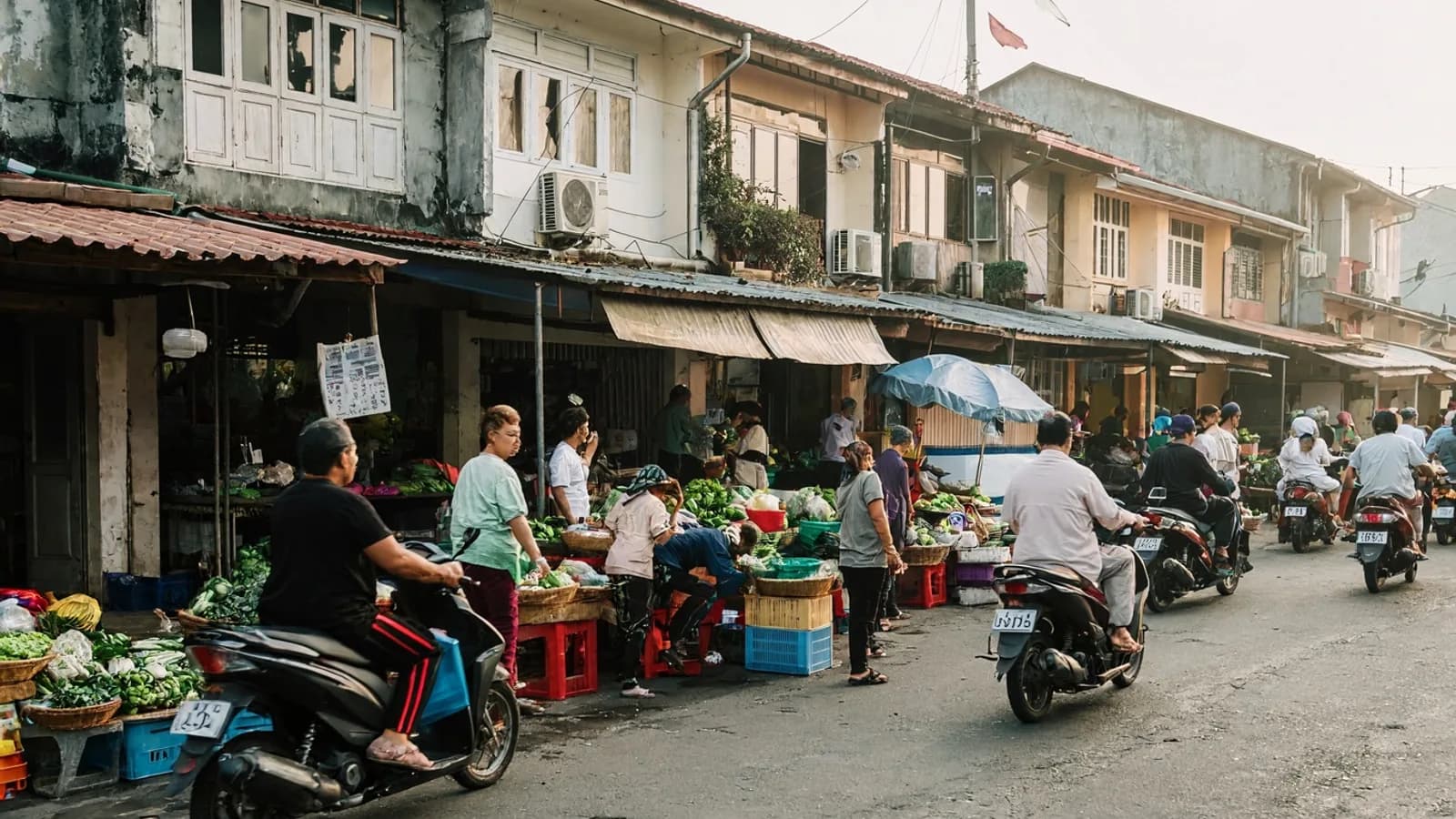
A traditional market often looks like the perfect location. From before dawn, people stream in by motorbike, pickup truck and on foot. Many owners conclude, "if I open in front of the market, I'll sell for sure." In reality, market crowds follow a very particular rhythm. They peak in the early morning, drop sharply towards midday, and in some regions are only truly packed on certain market days. If your opening hours, product and position do not match that rhythm, the crowd simply walks past your door.
This guide helps you judge whether a site near a traditional market suits your business, which position pays off best, and which risks to check before you pay the rent.
Why Market Locations Are Attractive, and Where the Traps Are
A market is a natural anchor. People come intending to shop, often carry cash, and usually stop at several places in one trip. Market shoppers also return regularly, some daily, others two or three times a week, which gives nearby businesses a real chance to build regulars.
There are three traps. First, crowds are concentrated in specific hours, so daily revenue can be much lower than the impression you get at peak time. Second, market shoppers tend to be price-sensitive, so premium products often struggle. Third, the market environment changes, through redevelopment, trader relocation or traffic reorganisation, and any of these can shift shopper flow away from your front door.
Understand the Market's Rhythm Before You Estimate Revenue
The daily rhythm
Many traditional markets come alive before dawn with wholesale trade between vendors, fill up with household shoppers in the morning, and start emptying towards midday. Some have an afternoon or evening session, such as a night vegetable market or food stalls that open after the main halls close. Do not assume; observe the actual opening and closing times of the market you are considering.
Market days and weekly patterns
In some regions, especially in Java, certain markets are busiest on particular days of the five-day Javanese market cycle (Legi, Pahing, Pon, Wage, Kliwon). Elsewhere, crowds follow weekends or specific weekdays. Ask long-standing vendors or the market office which days are busiest and quietest, and make sure your survey covers both.
Monthly and seasonal patterns
Market traffic also moves with paydays, the run-up to Ramadan and Lebaran, the new school year and, in farming areas, the harvest season. A business that only sells well at peak season needs a cash buffer for the slow months.
Businesses That Fit, and Those That Struggle, Near a Market
Fit comes down to one question: does your product complement what people are already doing at the market, or does it ask them to change their plans? The table below is a general picture; adjust it to local conditions.
Business type | General fit | Why | What to check |
|---|---|---|---|
Food stall, breakfast, quick coffee | High | Vendors and shoppers need a fast breakfast and drinks | How many similar sellers already operate inside the market |
Plastics, packaging, bulk spices | High | Serves market vendors and nearby food businesses | Loading access and whether you can offer credit terms |
Pharmacy or drugstore | Medium–high | Regular customers and urgent needs | Number of pharmacies nearby and their opening hours |
Banking agent, top-ups, bill payment | Medium–high | Vendors need daily deposits, withdrawals and transfers | Cash security and agent rules |
Motorbike repair and tyre patching | Medium | Many motorbikes arrive and park | Working space that does not block the road |
Concept café, premium salon, boutique | Low–medium | Market shoppers come for essentials and watch prices | Whether there is a separate afternoon or evening crowd |
Choosing a Position: Inside the Market, at the Entrance, or on the Approach Road
"Near the market" can mean very different spots. Compare the trade-offs before picking a unit.
Position | Advantages | Disadvantages |
|---|---|---|
Kiosk inside the market halls | Closest to shoppers, rent or levies often lower | Hours follow the market, management rules, limited space |
Shophouse right at the main entrance | Seen by almost every shopper, ideal for quick sales | Usually the highest rent, chaotic traffic and parking |
Shophouse on the approach road | Passed by shoppers before and after their trip, parking sometimes easier | You must confirm which road shoppers actually use |
Shophouse across the road | Often cheaper than the market side | Shoppers avoid crossing a busy road, especially with bags |
Also notice which entrance is busiest. Large markets usually have several, and the flow can be very uneven. The entrance closest to the minibus stop, motorbike-taxi base or motorbike parking is usually far busier than a side door.
Market-Specific Risks That Are Easy to Miss
Redevelopment or relocation plans. Rebuilding can move vendors to a temporary market for months, and shoppers move with them. Ask the market management, the market technical unit or the local trade office directly.
Street-vendor reorganisation. Clearing street vendors can make the road in front of you easier to use, but can also remove the bustle that drew shoppers in the first place.
Congestion and parking. At peak hours cars may struggle to stop. That helps businesses serving pedestrians and motorbikes but hurts those relying on car-driving customers.
Cleanliness, smells and puddles. Spots near the market's rubbish point, drains, or fish and meat stalls can put shoppers off lingering.
Extra charges. There may be levies, security fees, cleaning fees or parking charges. Ask for the details in writing before you agree.
Long quiet hours. If the market is practically empty after noon, work out whether you still need to pay staff and electricity until the evening.
Illustrative Example: Estimating Revenue by Time Block
The most common mistake is viewing a site at its busiest hour and multiplying by your opening hours. A safer method is to split the day into blocks and estimate transactions in each. The figures below are purely illustrative for a breakfast stall facing a market; replace them with your own field counts.
Time block | Market condition (example) | Estimated transactions per hour (illustration) | Hours | Total transactions (illustration) |
|---|---|---|---|---|
05:00–08:00 | Morning peak | 30 | 3 | 90 |
08:00–11:00 | Tapering off | 15 | 3 | 45 |
11:00–14:00 | Quiet | 5 | 3 | 15 |
14:00–17:00 | Nearly closed | 2 | 3 | 6 |
In this illustration, more than half the transactions happen in the first three hours, while the last six contribute little. You might do better opening from dawn to midday only, with fewer staff in the afternoon. Repeat the exercise for busy market days and ordinary days, then use the weekly average, not your best day, to judge how much rent you can afford.
Steps for Surveying a Site Near a Market
Find out the market's schedule. Ask about opening hours, the busiest and quietest days, and any special market days.
Visit at three different times: before dawn through the morning, midday and late afternoon. Repeat on a busy day and a quiet day.
Count passers-by in front of the site for 15 minutes per time block, separating pedestrians, motorbikes and cars.
Map entrances and shopper routes: from parking, minibus stops and motorbike-taxi bases to the market doors.
List competitors inside and outside the market selling similar products, including roaming sellers and street stalls.
Talk to long-standing vendors about changes in recent years: is the market getting busier or quieter, and have there been clearances, floods or fires?
Confirm the authorities' plans with the market office or relevant agency regarding redevelopment, relocation or road changes.
Recalculate using averages, then compare the result with the rent and extra charges.
For a picture of the population around the market, such as residents per district, you can use free publications from BPS. This helps you judge whether the market serves a wide residential area or just a small neighbourhood.
Field Checklist: Sites Near a Traditional Market
Market opening and closing times recorded, including market days or the busiest days
Passers-by counted in at least three time blocks on a busy day and a quiet day
The nearest entrance is a busy one, not a side door
The site sits on real shopper routes, not just close on the map
Shoppers do not need to cross a busy road to reach you
There is room for motorbikes to stop, and for cars if your business needs them
Not right next to a rubbish point, overflowing drain or strong odour source
No standing water or history of flooding according to nearby vendors
Redevelopment, relocation or clearance plans checked with the market office or agency
Levies, security, cleaning and parking charges known in advance
Competitors inside the market, outside it and roaming sellers listed
Your products and prices match market shoppers' spending power
Opening hours and staffing adjusted to the market's rhythm
Market crowds are an opportunity, but only for businesses open at the right hours, on the right route, at the right price.
Conclusion: Follow the Market's Rhythm, Not Your First Impression
A site near a traditional market can pay off handsomely for everyday essentials, morning food and services for vendors. The key is understanding when shoppers come, which way they walk, and what changes the market may face in the next few years. Your next step: ask for the market's schedule, plan surveys on a busy day and a quiet day, count transactions per time block, and check the result against the rent and your total costs before you decide.