Opening a Business in an Office District: Busy at Lunch, But What About Weekends and Work-From-Home Days?
Office districts promise long lunchtime queues, but they can go quiet at weekends, on public holidays and on work-from-home days. Learn how to estimate realistic weekly revenue and assess a site near offices.
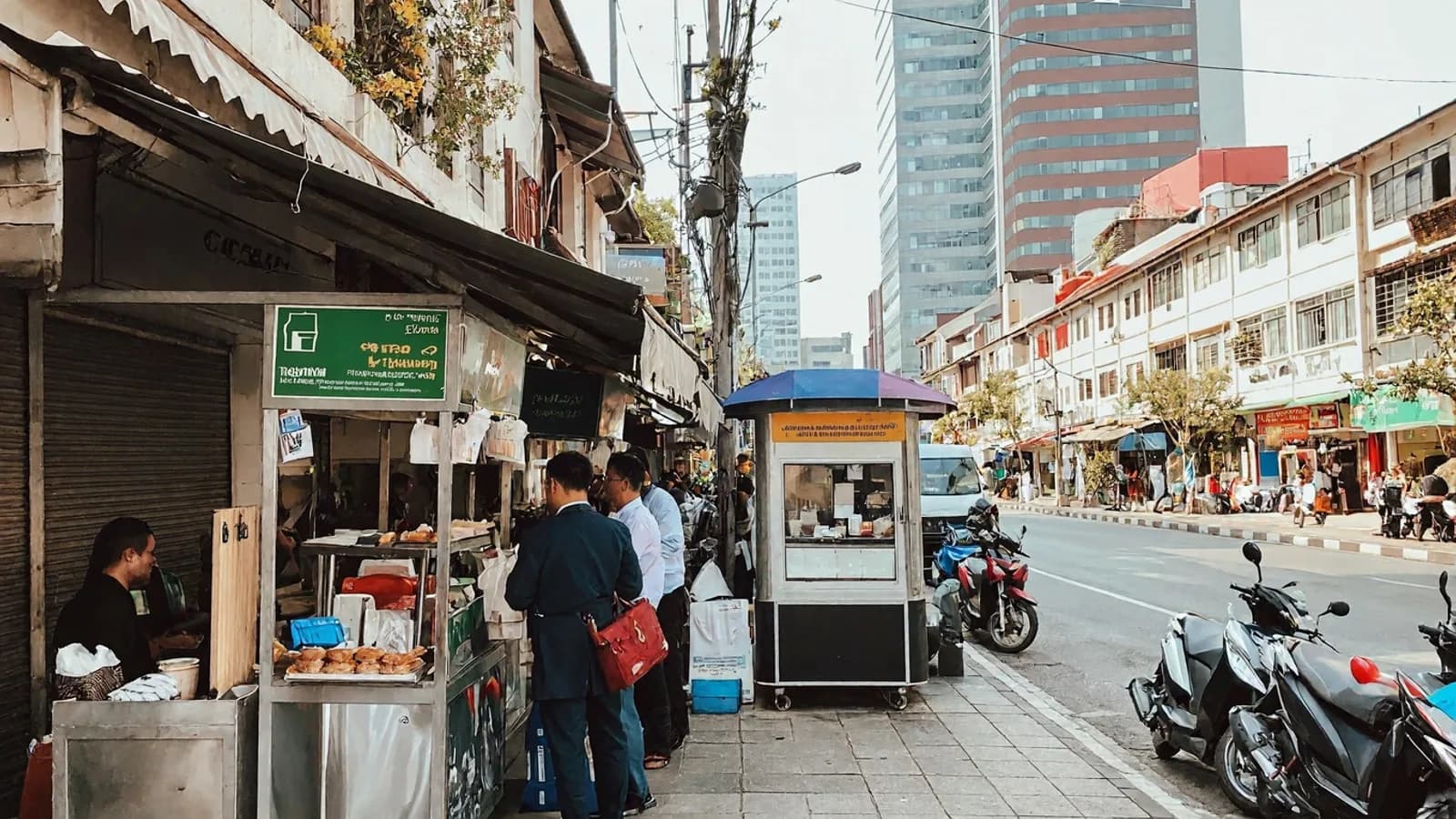
You stand outside an office building at noon and watch hundreds of employees pour out looking for lunch. The warung next door is packed and the coffee shop across the road has a queue onto the pavement. The site looks like a sure thing. The catch is that you saw it on a Wednesday. What about Saturday, Sunday, public holidays, collective leave days, or the days when many staff work from home?
This guide helps you assess a site near offices honestly: when buyers come, when they disappear, and how to estimate revenue that is not overly optimistic before you pay the rent.
Why Office Districts Are Attractive and Risky
Office workers are regular and predictable customers. They arrive at roughly the same time every day, have a daily food budget and tend to stay loyal to places that are fast and consistent. That is a big advantage over sites where footfall is random.
But the crowd is concentrated. In many office districts most transactions happen within a few hours, five days a week. Outside those hours the street can be empty. If your rent covers seven days but your customers only exist on five, the busy days must make up the difference.
Know What Kind of Office Area You Are Looking At
Not all office areas behave the same way. The table below is a general picture; check it against what you see on the ground.
Area type | Typical customer pattern | What to watch for |
|---|---|---|
High-rise towers in a business district | Very dense at lunch, lots of delivery orders | In-building canteens and food courts, high rent, quiet weekends |
Rows of office shophouses | Fewer employees, spread through the day | Offices can move or close, headcount is hard to judge |
Government offices | Regular hours plus visitors using public services | Public holidays and collective leave, rules on trading near offices |
Industrial estates or factories | Shift patterns, busy morning, afternoon and night | Factory canteens, estate access, changing shift schedules |
Read the Timing: Daily, Weekly and Yearly
Daily pattern
Many office areas have three waves: morning before work (coffee, breakfast), midday (lunch), and late afternoon before going home (snacks, drinks, household items). Your business should be strong in at least one wave, ideally two. A shop that only lives at lunchtime must be able to serve a queue very quickly.
Weekly pattern and work-from-home days
Some companies run hybrid working, and in some offices Mondays or Fridays look quieter than midweek. This is not the same everywhere, so do not assume it. Observe at least one Monday, one Wednesday and one Friday in person. Also note that on Fridays the lunch break often shifts because of Friday prayers, so the lunch queue may arrive later.
Yearly pattern
Mark the calendar: public holidays, collective leave and the Lebaran period when many employees travel home. During Ramadan, lunch patterns change completely and shift towards the time before breaking the fast. These months need their own calculation, not the same numbers as an ordinary month.
A Worked Example of Realistic Weekly Revenue
The most common mistake is counting Wednesday customers and multiplying by 30 days. Here is an illustration for a food stall near offices with an average spend of Rp25,000 per customer. The figures are only an example; replace them with your own counts.
Day | Estimated customers (illustration) | Estimated revenue |
|---|---|---|
Monday | 80 | Rp2,000,000 |
Tuesday | 130 | Rp3,250,000 |
Wednesday | 130 | Rp3,250,000 |
Thursday | 130 | Rp3,250,000 |
Friday | 80 | Rp2,000,000 |
Saturday | 20 | Rp500,000 |
Sunday | Closed | Rp0 |
Weekly total | 570 | Rp14,250,000 |
If an owner only looks at Wednesday and calculates 130 customers x 30 days x Rp25,000, the result is Rp97,500,000 a month. Using the weekly pattern above, a month (about 4.3 weeks) comes to roughly Rp61,000,000, and less in months with many public holidays. A gap that size can change the rent decision.
Steps to Estimate Demand from Nearby Offices
Map the buildings and offices within a reasonable walk, say 5 to 10 minutes. Note each building's name, approximate number of floors and type of tenants.
Ask about occupancy. Security staff, building managers or nearby shop owners often know whether a building is full, half empty or has just lost a tenant.
Check competitors inside buildings. Canteens, food courts and lobby minimarkets capture many customers before they ever step outside.
Count the lunchtime outflow. Stand at the main exit for 30 minutes and count people walking towards your site, not everyone who leaves.
Watch delivery orders. If many ride-hailing drivers wait in the lobby, some employees prefer to order in. Decide whether your business is ready to serve delivery.
Repeat on different days (Monday, Wednesday, Friday and Saturday) so the weekly pattern becomes clear.
Businesses That Fit and Those That Struggle
In general, the best fits serve employees' daily needs quickly:
Food stalls and boxed meals with a menu that can be served fast
Coffee and drinks, especially strong in the morning and at midday
Photocopying, printing and stationery
Laundry with pick-up and drop-off during working hours
Small pharmacies or minimarkets for quick essentials
On the other hand, businesses that rely on relaxed weekend visits, such as family cafés, toy shops or salons that peak on Saturdays and Sundays, should think twice before opening in an area that dies at the weekend.
Field Survey Checklist for Office Areas
Observed at least three different weekdays and one Saturday
Know the start, lunch and finish times of the main offices nearby
Asked building management or security about occupancy
Noted canteens, food courts and minimarkets inside the nearest buildings
Know whether a large office plans to move, a building is being renovated or a new one is coming
Checked that employees can walk safely to the site (pavements, crossings, cover in the rain)
Asked nearby owners what happens during Lebaran and collective leave
There are boarding houses, housing or schools nearby that could buy outside office hours
Kitchen and till capacity can handle the peak queue within 60 to 90 minutes
How to Avoid Depending on Weekdays Alone
If the office site is still attractive but the weekends are quiet, you can reduce the risk:
Negotiate the rent by showing the five-day pattern; some landlords in office areas are used to this argument.
Close or shorten hours on Sundays to save on wages and electricity.
Offer subscriptions or office catering so orders are more certain and can be placed a day ahead.
Find a second market, such as boarding-house residents or housing behind the office area, to fill evenings and weekends.
Conclusion
An office district can be an excellent location because its customers are regular and predictable. The key is not to be fooled by a busy Wednesday lunchtime. Observe several different days, estimate revenue per week, prepare a worst-month scenario and make sure the rent still makes sense with those numbers. Your next step: schedule visits on a Monday, Wednesday, Friday and Saturday at your candidate site, then fill in a weekly table like the example above with your own counts.