Choosing a Location for a Motorcycle Workshop: Traffic Flow, Waiting Space, Neighbours' Approval and Other Must-Checks
A motorcycle workshop needs more than a busy road. Learn how to tell emergency customers from routine-service customers, assess motorbike traffic, forecourt space, power supply and neighbours' approval, and check whether the rent makes sense.
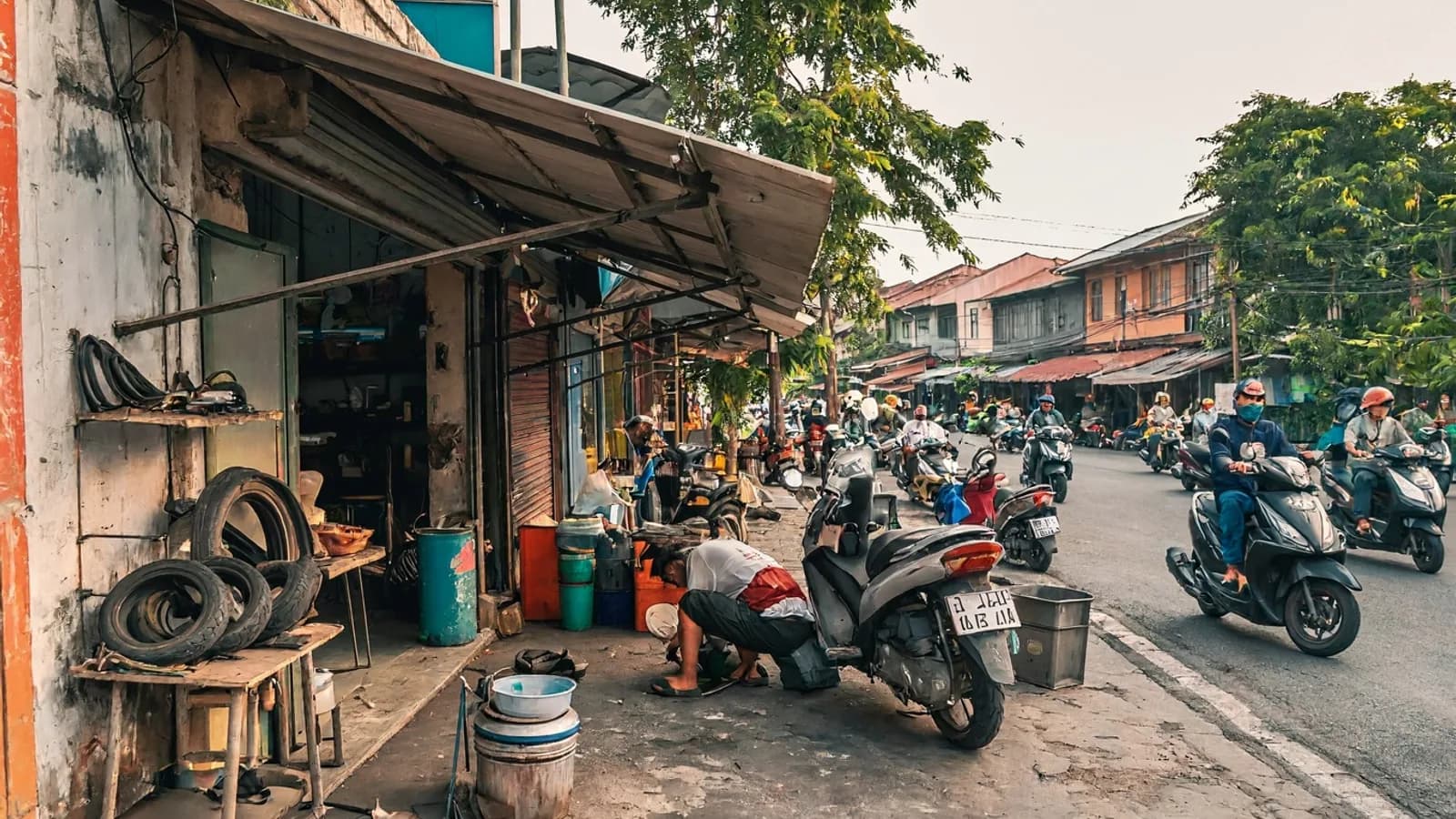
Many would-be workshop owners keep it simple: find a road full of motorbikes, rent a space, put up a sign and wait for customers. In practice, a workshop can be quiet on a packed road, or busy but facing complaints from neighbours about noise and the smell of oil. A motorcycle workshop has different needs from a warung or a regular shop: bikes have to be parked while they wait, the compressor needs serious power, and used oil has to be disposed of properly.
This guide helps you assess a potential workshop site in practical terms, from the kind of customer you want to serve to a rent-versus-revenue calculation. All numbers in this article are illustrations you should check against conditions in your own area.
Know Your Two Types of Customer
Before looking at any site, understand that workshop customers arrive for two very different reasons, and each needs a different kind of location.
Emergency customers
A flat tyre, a snapped chain, a dead battery or a bike that breaks down mid-journey. These customers do not choose a workshop; they look for the nearest one they can see. For them, a position on a route used by many motorbikes and visible from both directions matters far more than price or brand. Tyre-patch stalls and small roadside workshops depend heavily on this group.
Routine-service customers
Oil changes, scheduled servicing, brake pads or planned repairs. These customers usually come from homes, boarding houses or offices not too far away, and they tend to stay loyal once they trust a mechanic. For them, being close to where they live, a comfortable place to wait and trust matter more than a very busy road.
Reading Vehicle Flow at a Potential Site
A road full of cars is not necessarily full of motorbikes, and a road full of motorbikes is not necessarily easy to stop on. During your survey, look at the following.
Vehicle mix. Count motorbikes passing in 15 minutes during the morning commute, midday and the evening. Compare with the number of cars. Routes dominated by motorbikes are more promising.
Speed. Bikes moving fast on a wide road struggle to stop suddenly. Roads with moderate speeds, near traffic lights or junctions, make it easier for riders to pull over.
Ride-hailing riders and couriers. They ride all day and often need quick servicing. Check whether there is a base or gathering point for them nearby.
Where routine customers come from. Watch where residents of housing estates and boarding houses enter and leave. A workshop on the side they pass on the way home is easier to visit in the evening.
Road medians. If a long median has no U-turn near the site, riders from the opposite direction may not bother making a long detour.
The most honest way to judge demand is to watch an existing workshop near your potential site. Sit at a warung across the road for an hour or two and note how many bikes come in, what kind of work they need and how long they wait. If you can, talk to workshop owners in similar areas elsewhere about their busy days and hours.
Forecourt, Building and Utilities
This is the most underestimated part. A shophouse that suits a clothing shop can be a poor fit for a workshop.
Space for waiting bikes
Bikes waiting their turn have to go somewhere. If the forecourt is narrow, customers' bikes spill onto the road shoulder, block traffic and can draw complaints from residents or officials. Measure the front area and estimate how many bikes fit without blocking the road or the neighbours' doors.
Floor, depth and drainage
The floor should be solid concrete that is easy to clean of oil spills.
The unit should be deep enough for a work area, spare-parts shelving and bikes kept overnight.
There should be drainage, but make sure used oil never goes into the gutter. Prepare containers and find a used-oil collector in the area.
The site should not be prone to flooding, which can ruin tools and parts stock.
Power and water
Air compressors, drills and other tools can draw a lot of power, especially when running at the same time. Ask about the building's installed electricity capacity and whether the owner allows an upgrade. Agree on the cost of any upgrade and who pays for it before you sign. Clean water is also needed for handwashing, cleaning parts and keeping the work area tidy.
Neighbours, Noise and Permits
A workshop produces compressor noise, hammering, engines being revved and the smell of oil and petrol. In a densely residential area this can lead to complaints. Before you lease:
Meet the head of the RT or RW and explain your plans, including opening hours.
Ask whether there has been a workshop in the neighbourhood before and how residents reacted.
Note who is directly to the left, right and behind. Homes sharing a wall are more sensitive to noise than shops.
Check zoning and the KBLI code for motorcycle repair through OSS or the relevant local office.
Make sure the lease does not prohibit a workshop, and ask the owner directly whether they object to noisy, oily work.
Competitors and Suppliers Nearby
Map every workshop within a realistic radius for your customers, for example a few hundred metres for emergencies and one to two kilometres for routine servicing. Separate them by type: brand-authorised workshops, general workshops, specialists (such as fuel injection or electrics) and roadside tyre patchers. Several workshops on one stretch is not necessarily bad, as long as you have a clear edge, such as longer hours, a specialist mechanic or shorter waits.
Do not forget the distance to a spare-parts shop. A workshop that has to wait a long time for parts keeps customers waiting longer too. A parts shop nearby, or a supplier willing to deliver, is a real advantage.
Comparing Workshop Location Types
Location type | Best for | Strengths | Main risks |
|---|---|---|---|
Main road | Breakdowns, tyre repairs, quick service | Heavy bike traffic, high visibility | High rent, fast traffic, often a narrow forecourt |
Connector road to housing | Mix of emergency and routine service | Moderate speed, close to regulars | Lower volume, trust takes time to build |
Near a campus or boarding houses | Routine service and cheap oil changes | Many young riders | Quiet in semester breaks, price-sensitive |
Near a ride-hailing gathering point | Quick service and light repairs | High-frequency repeat customers | Very sensitive to price and waiting time |
Inside a housing estate | Scheduled servicing and regulars | Cheaper rent, loyal customers | Noise complaints, hard for outsiders to find |
Worked Example: Rent Versus Expected Revenue
Here is an illustration comparing two potential sites. Bikes per day and average spend are examples only; replace them with what you observe at nearby workshops and local service prices.
Item (illustration) | Site A: main road | Site B: connector road |
|---|---|---|
Estimated bikes per day | 30 | 20 |
Average spend (labour + parts) | Rp60,000 | Rp60,000 |
Open days per month | 26 | 26 |
Estimated monthly revenue | Rp46,800,000 | Rp31,200,000 |
Monthly rent | Rp6,000,000 | Rp3,000,000 |
Rent as share of revenue | about 12.8% | about 9.6% |
In this example, Site A brings in more revenue, but rent takes a bigger share. Remember that workshop revenue includes parts, which carry thinner margins than labour, so also work out how much of your revenue really comes from labour. If you are unsure of your bike estimate, use a pessimistic scenario and make sure the business can still cover rent, mechanics' wages and electricity.
Field Checklist for a Workshop Site
Motorbikes passing per 15 minutes recorded for morning, midday and evening.
Traffic speed in front of the site lets riders pull over safely.
The workshop is visible from both directions, with a U-turn not too far away.
The forecourt fits several waiting bikes without using the road.
The floor is solid and not slippery, and the site is not flood-prone.
Power is enough for a compressor and tools, or the owner agrees to an upgrade.
Clean water is available and there is a plan for storing used oil.
The RT or RW head and close neighbours have been met and do not object.
Zoning and the KBLI code for motorcycle repair have been checked.
The lease does not prohibit workshop activity.
Competing workshops nearby are mapped along with their strengths.
The nearest parts shop or a delivering supplier is known.
A rent-to-revenue calculation has been done with a pessimistic scenario.
Steps From First Search to Signing
Decide your mix of emergency and routine-service customers.
Shortlist two or three sites that suit that mix.
Survey vehicle flow and watch nearby workshops at different times.
Measure the forecourt and check the building, power, water and flood risk.
Meet neighbourhood leaders and neighbours, then check permits and zoning.
Calculate rent against expected revenue under normal and pessimistic scenarios.
Negotiate the lease, including the power upgrade and permission for workshop activity, before you pay.
Conclusion
A good workshop location is not just about a busy road; it is about matching your customer type, the vehicle flow, space for waiting bikes and acceptance from the neighbourhood. Start by deciding who your main customers are, then take the checklist above on your survey. Record real numbers in the field, compare several sites using the same calculation, and do not sign until power, neighbours and permits are settled.