Choosing a Location for an Electronics and AC Repair Business: Home-Call Customers, Drop-Off Items, Workspace and Other Must-Checks
An electronics and AC repair business does not live on passing trade but on households and small offices whose appliances break or whose AC needs cleaning. Learn how to read customer sources, call-out radius, drop-off space and the rent maths.
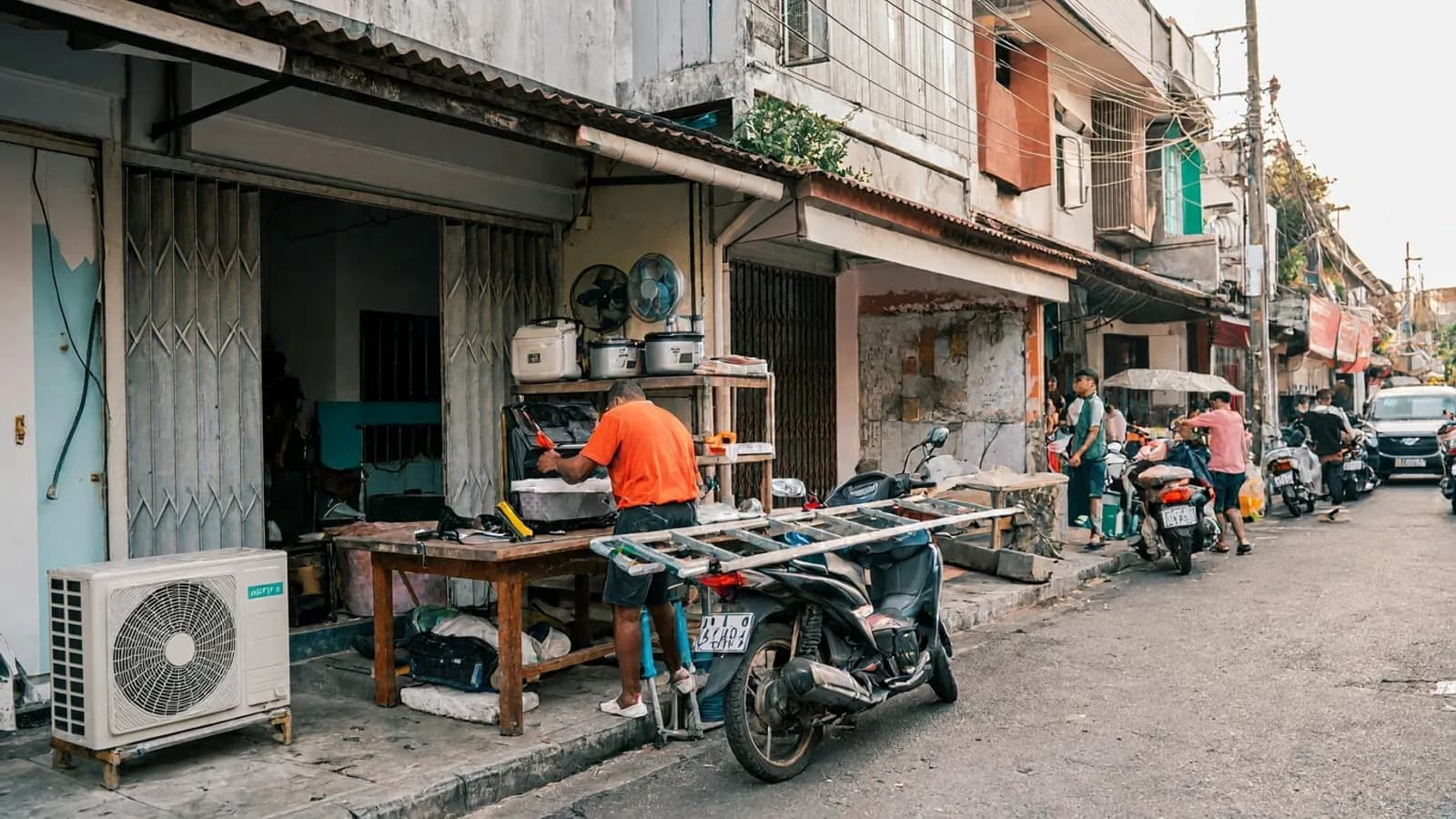
You know how to fix TVs, washing machines, fridges or air conditioners, and you want to open your own repair shop. The catch is that a repair business cannot be judged like a food stall or a coffee shop. Almost nobody walks into a repair shop just because they happen to pass by. Customers come because something broke, or you go to them. This guide helps you assess potential sites from the right angle: where customers come from, how far your technicians must travel, and whether the space can hold the items people leave with you.
Start with your service model
Before looking at shophouses, decide where most of your revenue will come from. Repair businesses usually have two income streams with very different location needs.
In-shop repairs (drop-off): customers bring small or medium items such as TVs, fans, rice cookers, speakers or pump motors. Here the site must be easy to reach by motorbike, with somewhere to stop briefly and unload.
Call-out repairs (technician visits): AC cleaning and repair, installed washing machines, fridges and water pumps. Here a busy road matters less than how many homes and offices a technician can reach quickly.
Many repair businesses do both. Estimate the split, for example 60 percent call-outs and 40 percent drop-offs. The bigger the call-out share, the more freedom you have to choose a cheaper unit on a secondary road, as long as it sits close to dense housing and offices.
Reading customer sources around a site
Potential repair customers can be spotted directly in the field. As you walk or ride around, look for these signs.
Outdoor AC units on house and shop walls. Do a rough count along a few streets. Lots of units means a recurring market for cleaning and repairs.
Age of the housing. Homes that have been lived in for some years usually have appliances starting to need repairs. Brand-new estates are often still under manufacturer warranty.
Boarding houses and rentals with AC. Landlords often become regular customers because they manage many units at once.
Small offices, clinics, private schools and shophouse businesses. They need regular AC servicing and tend to look for a go-to technician.
Restaurants and shops with fridges or freezers. A cooling breakdown is urgent for them, so they call whoever is closest.
For a wider picture, compare population and household numbers by district in the Kecamatan Dalam Angka publications from BPS. These figures will not tell you how many AC units an area has, but they help you see which districts are denser before you survey.
Measure call-out radius in travel time, not distance
A technician who spends 40 minutes on the road per job can only serve a handful of customers a day. Set a realistic travel limit, for example 15 to 20 minutes by motorbike at busy times. Then test it yourself: ride from the candidate site to several target estates at 9 am and 4 pm. A route that looks short on the map can be slow because of traffic, long U-turns or one-way streets.
Drop-off items and workspace
This is the most underestimated point. Repairs rarely finish in a day. Some items wait for parts; others are done but not yet collected. Within a few months your shelves can fill up with customers' TVs, fans and washing machines. A cramped space means items get stacked, mixed up and damaged.
Space need | What it is for | What to check on site |
|---|---|---|
Workbench and tool racks | Opening up and testing small items | Wall length for benches, lighting, enough sockets |
Drop-off shelving | Holding items awaiting repair or collection | Tiered space, safe from leaks and rats |
Large-item area | Washing machines, fridges, freezers | Door width, level floor, step-free access |
Parts and refrigerant store | Spare parts, refrigerant cylinders, AC piping | Ventilated room, away from heat sources |
Technician parking | Motorbikes carrying ladders and tools | Forecourt or yard that does not block neighbours |
If you also accept washing machines and fridges, avoid sites reached only by stairs or narrow alleys. Hauling a fridge up to a second floor every week wears you out and risks damaging customers' property.
Power, water, noise and neighbours
Electrical capacity: testing an AC, a fridge and a washing machine at once needs enough power. Ask about the installed capacity and estimate the cost of an upgrade if it falls short.
Water and drainage: if you wash AC parts in the shop, make sure there is a tap and a drain that will not leave the floor or the road outside wet.
Noise: compressors, drills and speaker tests can be loud. A unit next to quiet homes or boarding houses is more likely to draw complaints.
Local rules: some housing estates and managed shophouse blocks restrict workshop activity. Ask the management or the neighbourhood head (RT) before you pay.
Checking rent against expected revenue
Because repair customers do not depend on a main road, you do not need to pay prime-street rent. Still, check that the rent makes sense against expected income. The table below is purely an illustration with example figures; replace them with local rates and costs after asking a few technicians and shophouse owners in your area.
Item (illustration, per month) | Example calculation | Example value |
|---|---|---|
AC cleaning and light servicing | 80 units × Rp80,000 | Rp6,400,000 |
Electronics repair labour | 40 jobs × average Rp150,000 | Rp6,000,000 |
Margin on spare parts | Rough estimate | Rp2,000,000 |
Total gross revenue | Rp14,400,000 | |
Shophouse rent | Rp45 million a year ÷ 12 | Rp3,750,000 |
Power, water, technician fuel | Estimate | Rp2,300,000 |
One assistant technician | Example | Rp3,000,000 |
Left before other costs and owner's pay | Rp5,350,000 |
In this illustration, rent takes about a quarter of gross revenue. If another site costs much more but would not bring in more call-outs, it is hard to justify. On the other hand, a cheap unit far from housing will push up fuel costs and technician time.
Competitors and parts suppliers
Find out how many repair businesses operate within your call-out zone, including home-based technicians who only advertise on social media or with stickers on lamp posts. Lots of AC technician stickers in one area signals real demand but also tight price competition. Stand out through specialisation, a repair guarantee or longer service hours.
Also note the distance to electronics parts shops and AC supply stores. If the nearest parts shop is an hour away, every item waiting for a component sits on your shelf longer and customers wait longer too.
Field survey checklist
Count outdoor AC units along three to five streets around the site.
List estates, boarding houses, small offices, clinics and restaurants within 15 minutes.
Test motorbike travel time to target estates in the morning and afternoon.
Measure the door width and confirm a washing machine or fridge can come in without steps.
Work out shelf space for drop-off items, enough for at least a few weeks of backlog.
Ask about installed electrical capacity and the cost of an upgrade.
Check for a water tap and drainage for washing components.
Ask the management or RT about rules on workshop activity and noise.
Look for repair shops and home-based technicians nearby, including stickers and social media.
Note the distance to the nearest electronics parts and AC supply shops.
Make sure there is parking for technicians' motorbikes that will not bother neighbours.
Conclusion
For an electronics and AC repair business, the best site is not the busiest one but the one closest to many homes, boarding houses and offices that need you, with enough room to work and store customers' items. Next step: shortlist two or three candidate sites, draw a 15-minute travel zone around each, run through the checklist above, then plug your rent and estimated call-outs into the calculation table. The site that comes out on top is the one worth negotiating for.