Choosing a Business Location on an Intercity Road: Long-Distance Drivers, Stopping Points, Holiday Rush and the Threat of a New Toll Road
Intercity roads carry thousands of vehicles, but only a few ever stop. Learn who actually pulls over, how to pick a natural stopping point, how to model normal months against the holiday rush, and how to check the risk of a new toll road.
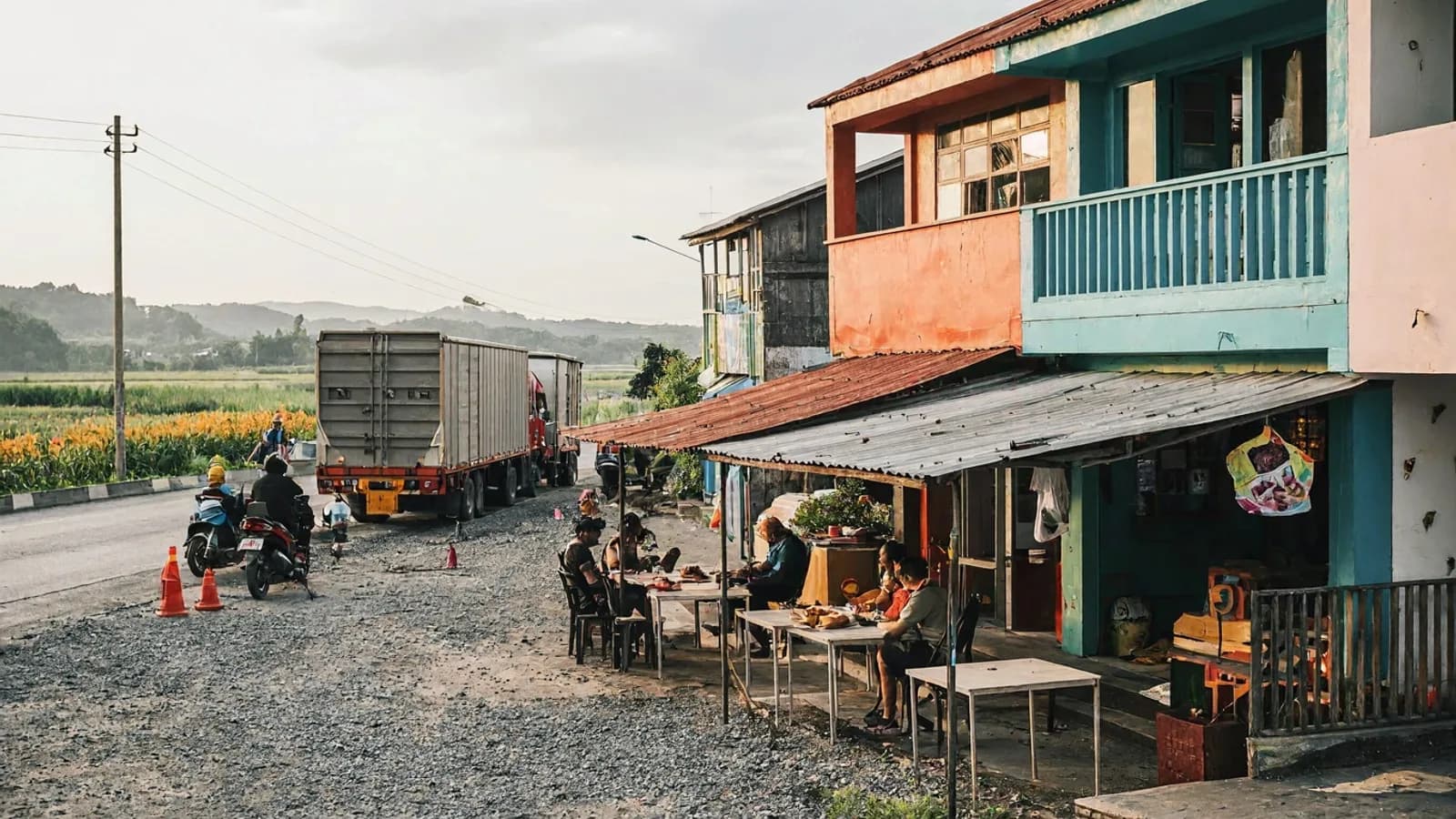
A provincial or national road linking two cities looks very tempting: trucks, buses, family cars and motorbikes pass from morning to night. Yet many eateries, coffee stalls and souvenir shops along these routes are quiet. The problem is that vehicles passing at speed are not the same as customers. This guide helps you judge whether a spot on an intercity road is genuinely viable before you pay rent or build there.
Heavy Traffic Is Not the Same as People Stopping
On a city street, passers-by often live or work nearby and can come back tomorrow. On an intercity road, most drivers pass once and are pressed for time. They stop out of need: hunger, a toilet break, tiredness, prayer, fuel or buying gifts to take home. So the key question is not how many vehicles pass, but where they feel they need to stop, and whether your business is at that point.
Know which travellers stop
Traveller type | Why they stop | What they want | Location notes |
|---|---|---|---|
Truck and logistics drivers | Rest, meals, a short sleep | Cheap, filling food, coffee, toilets, big parking | Need a large, safe forecourt; often busy at night |
Intercity buses and shuttles | Scheduled meal stops | Restaurants with an arrangement with the operator | Usually by agreement, not chance |
Family and holiday cars | Meals, toilets, prayer room, gifts | Clean space, decent toilets, room for children | Busy at weekends and in holiday seasons |
Long-distance motorcyclists | Fatigue, heat, rain | Shade, drinks, small repairs | Strongly affected by weather |
Local residents | Daily needs | Fair prices, reliable hours | Carry you through quiet days |
Decide which type is your main target first. A coffee stall for truck drivers and a family restaurant can sit on the same road, but their location needs are very different.
Reading the Natural Stopping Points Along a Route
Drivers tend to stop after a certain distance or time, say after two or three hours on the road, or before a climb, a forest stretch or a long section with no settlements. These points are often already marked by a petrol station, a large roadside mosque or a row of long-standing eateries.
Map the route from origin to destination. Note where petrol stations, mosques, rest areas and large eateries are, and the distances between them.
Look for long empty stretches. The last point before a quiet stretch, or the first one after it, is usually a natural stop.
Consider the direction of travel. Drivers who have just left a city rarely stop in the first 30 minutes, and those nearly home tend to push on. Mid-journey spots have better odds.
Look for stopping magnets. Petrol stations and mosques with clean toilets bring in people who have already pulled over. Being right next to or opposite one can help a lot.
Ask drivers directly. Truck and bus drivers at stalls or petrol stations usually know exactly where they stop and why.
Road Side, Speed and Ease of Pulling In
Vehicles on intercity roads travel much faster than in town. Drivers need to see your place from a distance and have enough room to slow down and pull in safely. Sites on sharp bends, steep descents or right after a bridge are often simply missed.
Road side: if the road has a median, you only serve one direction. Check which direction carries more of your target, for example towards a holiday town on Friday evening and back on Sunday evening.
Sight distance: from a few hundred metres away, can drivers already see the building, sign and forecourt? Test it by driving past at normal speed.
Entry and exit: the entrance must be wide enough for trucks or buses, and vehicles must be able to rejoin the road without reversing into traffic.
Road shoulder: a wide, level shoulder makes it easier for motorbikes to pull over, especially in the rain.
Parking, Toilets and a Prayer Room Are Part of the Product
On a highway, facilities often matter more than the menu. Families will not stop without a decent toilet. Truck drivers will not pull in if the yard cannot fit one large vehicle. Work out the space you need for your target: one large truck or bus takes far more room than several cars.
Check the water source for toilets and kitchen too, since many highway stretches have no piped water. Ask whether the well runs dry in the dry season. Check the power supply as well: how often it cuts out, and whether you will need a generator to open around the clock.
Model a Full Year, Not Just the Holiday Rush
During the Lebaran homecoming, Christmas and New Year, or long weekends, intercity roads can be jammed and roadside stalls overwhelmed. But those peaks last only a few weeks a year, while rent, wages and power are due every month. The example below is purely an illustration of the method; get real figures from your own survey and from talking to owners on that route.
Period (illustration) | Days | Example transactions per day | Example spend per transaction | Example revenue |
|---|---|---|---|---|
Ordinary weekdays (Mon–Thu) | about 190 | 40 | Rp30,000 | Rp228,000,000 |
Ordinary weekends | about 140 | 70 | Rp35,000 | Rp343,000,000 |
Homecoming and long holidays | about 35 | 200 | Rp40,000 | Rp280,000,000 |
Full year | 365 | Rp851,000,000 |
In this illustration the holiday season is big, but ordinary weekdays and weekends still carry most of the year. If ordinary days at your site turn out to be very quiet, the whole calculation can collapse. Compare your figures with your total annual costs, then ask: would the business still make money if this year's holiday rush were weak because of weather, traffic rules or diverted flows?
The Biggest Threat: A New Toll Road or Alternative Route
Many businesses on old national roads lose customers after a parallel toll road opens, as long-distance traffic moves onto it. This is a risk you must check before signing a long lease, especially if you are targeting trucks, buses and holiday travellers.
Find out about toll plans for the corridor. Ask the village or district office, follow local news and check official information from the Ministry of Public Works or the local government.
Check where the nearest toll exits will be. Sites near an exit sometimes benefit, while mid-route stretches that the toll bypasses can be left behind.
Ask long-standing owners. On routes elsewhere that already have a toll road, ask stall owners how much it affected them.
Check alternative routes and holiday traffic management. Police sometimes divert flows during the homecoming season, so your stretch may be skipped on the busiest days.
Match the lease length to the risk. If a toll road is clearly planned, avoid long leases paid upfront, or ask for a clause that gives you a way out.
Local Residents and Area Data as a Buffer
Long-distance drivers come and go, but the villages and districts along the route stay. Look up the population and density of the district in the Kecamatan Dalam Angka publications on the BPS website. This helps you judge whether there are enough local buyers to carry you through quiet days. Back it up with a field survey: are there schools, markets, village offices or dense housing close by?
Security, Night Operations and Staffing
Many highway businesses are busy at night, especially those serving truck drivers. Make sure road and forecourt lighting is adequate, ask residents about the area's safety history, and plan who will be on duty. Find out too whether you can hire from nearby villages, since sites far from housing often struggle to find staff willing to work night shifts.
Field Checklist for an Intercity Road Site
Who is the main target: truck drivers, buses, families, motorcyclists or local residents?
How far is the nearest stopping point before and after the site (petrol station, mosque, rest area, other eateries)?
Is the site mid-journey rather than too close to the origin or destination city?
Is the place clearly visible from a few hundred metres at normal speed?
Is there a median? Which direction can you serve?
Are the entrance and yard big enough for trucks or buses, with a safe way back onto the road?
Are there decent toilets and a prayer room, or space to build them?
What is the water supply like in the dry season, and how often does the power cut out?
How does the site look on weekdays, weekends, at night and in the rain?
Are there plans for a toll road, alternative route or holiday traffic diversions in this corridor?
What is the district population according to BPS, and is there housing nearby?
What are the lighting, night-time security and local staffing like?
What do 5 to 10 drivers and 2 to 3 business owners on the same route say?
Conclusion: Look for a Stopping Point, Not Just a Busy Road
A business on an intercity road can do very well if it sits where people naturally want to stop, offers the right facilities and still survives outside the holiday season. Your next steps: map the route and its existing stops, survey on ordinary weekdays and weekends, talk to drivers and nearby owners, model a full year using your own survey figures, and check toll road plans before you sign a long lease.