Test the Location First: How to Trial a Market With a Booth or Pop-Up Before a Long Lease
Before paying a year's shophouse rent upfront, you can test real demand in an area with a booth, a bazaar stall, consignment or a short lease. Learn how to design the trial, what to record and how to read the results.
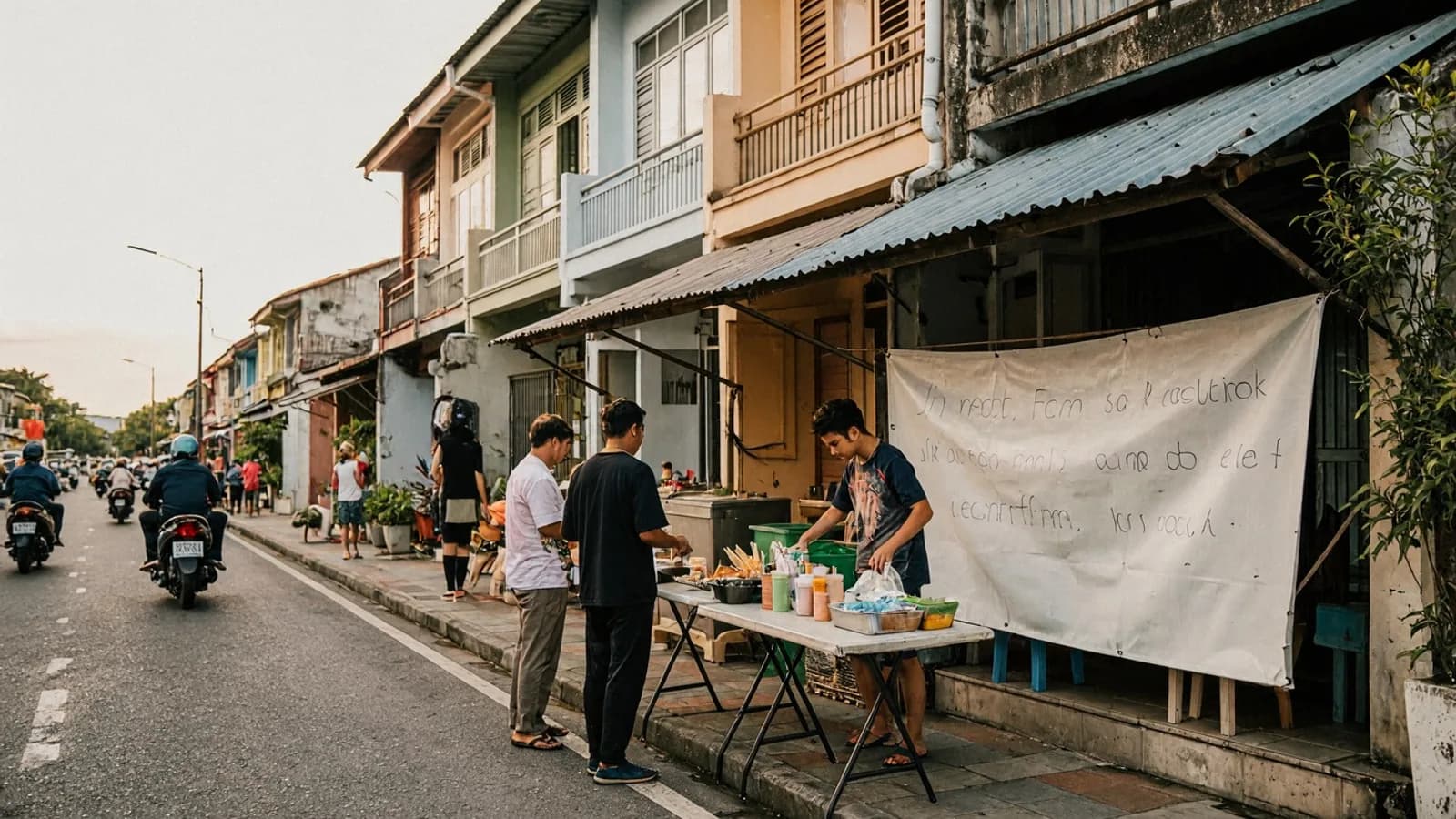
You have surveyed the site, counted passers-by and read the demographic data. Everything looks promising. But the landlord wants two years' rent upfront, and one question still nags: will people in this area actually buy what I sell? A survey tells you who walks past; it cannot tell you who will spend money. That is where a location trial helps: selling on a small, low-cost scale for a few weeks before committing to a long lease.
Why Test a Location Before Signing a Long Lease
Business rents in Indonesia are often paid a year or more in advance, on top of fit-out costs you cannot take with you if the business fails. That means a poor location choice usually only becomes clear after most of your capital is gone.
A trial reverses the order. You spend a small amount to get real sales data from the area, then decide whether a permanent site is worth it. It does not replace a field survey or a break-even calculation; it adds the most important evidence of all: transactions.
Tests buying intent, not just crowds.
Tests pricing: whether local customers accept the price you plan to charge.
Tests peak hours: when buyers actually come, not when the road just looks busy.
Builds early customers: WhatsApp contacts or social followers you can reach when the permanent shop opens.
Ways to Run a Trial and What Each Offers
Not every method suits every business. The table compares common options. Costs and availability vary a lot by city and by venue, so ask local organisers or landowners directly.
Trial method | Best for | Strengths | Limitations |
|---|---|---|---|
A stall at a bazaar, car-free day or night market near the site | Food, drinks, small retail | Low cost, quick to try | Event visitors differ from everyday visitors |
A booth or table in front of another shop on the same street | Coffee, snacks, accessories | Very close to the target site | Needs permission from the owner and neighbourhood; limited space |
Consignment in nearby warung or shops | Packaged food, cakes, home products | Almost no rent | Sales depend on how the other shop displays your goods |
A delivery test targeting specific areas | Food, laundry, services | Measures demand from nearby housing | Does not test walk-in customers |
A short 1 to 6 month lease on an empty unit | Almost any business | Closest to real conditions | Not every landlord agrees; monthly rent may be higher |
Steps to Design a Trial You Can Actually Read
Selling without a plan gives you impressions, not data. Follow these steps so the results can support a decision.
Write down the question you want answered. For example: "How many transactions a day can I get on this street on weekdays and weekends?" or "Will customers accept Rp25,000 a cup?"
Set a minimum duration. Try to cover several weekdays, several weekends and at least one period before and after payday. Four weeks is often a sensible starting point; one or two days is almost always too short.
Sell the same core products. Do not test with a menu very different from your planned shop. If the booth can only carry part of the menu, choose the items that best represent your sales.
Use your planned prices. Heavy discounts during a trial make sales look higher than they will be. If you run promotions, keep them limited and record them separately.
Open during your planned hours, or at least during the peak hours you are assuming, so you can confirm or disprove that assumption.
Record every day in the same format (see the list below) rather than relying on memory.
What to Record Every Day
Transactions per hour, not just the daily total.
Average spend per transaction.
Best and worst-selling products.
Weather, nearby events and anything unusual (such as a road closure or heavy rain).
Where buyers come from if possible: ask briefly, "Do you live or work around here?"
Repeat customers. This is a key sign of steady demand rather than curiosity.
Questions or requests you could not yet meet.
Reading the Results: A Worked Example
Trial figures cannot be copied straight into a forecast for a permanent shop. Two effects need allowing for. First, the novelty effect: people often try something new and some never come back. Second, the format effect: a permanent shop is usually more visible, has seating and a fuller menu, so it may sell more than a booth. These may or may not cancel out, so a conservative estimate is safer.
Here is an illustration for a drinks kiosk that ran a booth for four weeks. The numbers only show how to calculate; they are not market benchmarks.
Item | Example figure | Notes |
|---|---|---|
Average weekday transactions | 25 per day | From daily booth records |
Average weekend transactions | 40 per day | From daily booth records |
Transactions per week | (5 × 25) + (2 × 40) = 205 | Simple calculation |
Transactions per month | 205 × 4.3 ≈ 880 | Average weeks per month |
Average spend per transaction | Rp20,000 | From till records |
Estimated gross monthly revenue | ≈ Rp17.6 million | 880 × Rp20,000 |
Conservative novelty discount (e.g. 20%) | ≈ Rp14 million | An assumption you can adjust |
Compare this conservative figure with the minimum revenue needed to cover rent, wages, ingredients and other costs at the permanent site. If the conservative estimate still clears break-even comfortably, the site deserves serious consideration. If it only breaks even under the most optimistic assumptions, treat that as a warning.
Watch the weekly trend too. Sales that rise or hold steady from week one to week four are more convincing than sales that start high and keep falling, even if the totals are the same.
Field Checklist During the Trial
Permission from the owner, area manager or RT/RW obtained, in writing if possible.
The booth is on the same side of the road and at or very near the target site.
Products and prices match the planned permanent shop.
A daily record sheet (or till app) is ready and filled in every hour.
The trial covers weekdays, weekends and payday.
Weather and unusual events are noted each day.
There is a way to collect customer contacts (a stamp card or WhatsApp group, for example).
Repeat customers are counted separately.
Customer questions about other products or opening hours are logged.
Results are recalculated with a conservative discount before comparing with break-even.
When a Trial Is a Poor Fit
A trial is not the answer for every business. In some situations results are hard to read or the trial is impractical:
Businesses that need heavy equipment or special permits, such as pharmacies, clinics or workshops, are hard to test with a booth. Use customer surveys, consignment of related products or interviews with similar business owners elsewhere instead.
Businesses built on long-term regulars, such as laundries or salons, take longer to form habits. Four weeks of results may understate the real potential.
Sites where temporary selling is not possible, for example because of area rules or a narrow pavement.
Unrepresentative timing, such as Ramadan, school holidays or roadworks, unless that is exactly what you want to test.
Keeping the Site Available While You Test
The risk of a trial is that someone else leases the unit while you are still testing. Talk openly with the landlord: some will give you first refusal or hold the unit for a few weeks against an agreed deposit. If you agree to this, write down the terms clearly, including whether the deposit is refunded if you walk away. When you draft the lease itself, check the key points in our guide to shophouse lease clauses.
Another option is to negotiate a shorter initial lease with a renewal option. The monthly rate may be a little higher, but your risk is far lower, and the trial becomes your first months of trading.
A survey tells you who walks past. A trial tells you who pays.
Conclusion: Pay a Little for Data Before You Pay a Lot for Rent
A location trial is a cheap way to turn guesses into numbers. Your next step: pick the trial method that best fits your business, write down the question you want answered, prepare a record sheet, and run it for at least a few weeks covering weekdays, weekends and payday. Then calculate a conservative revenue estimate and compare it with break-even at the permanent site. If the numbers hold up, you can sign the lease with far more confidence.