Business Location Survey Checklist: Check by Day, at Night and in the Rain
One midday visit shows only one side of a potential site. Here is a visit schedule, a checklist for access, the building, electricity, flooding and safety, and the questions to ask the neighbours before you lease.
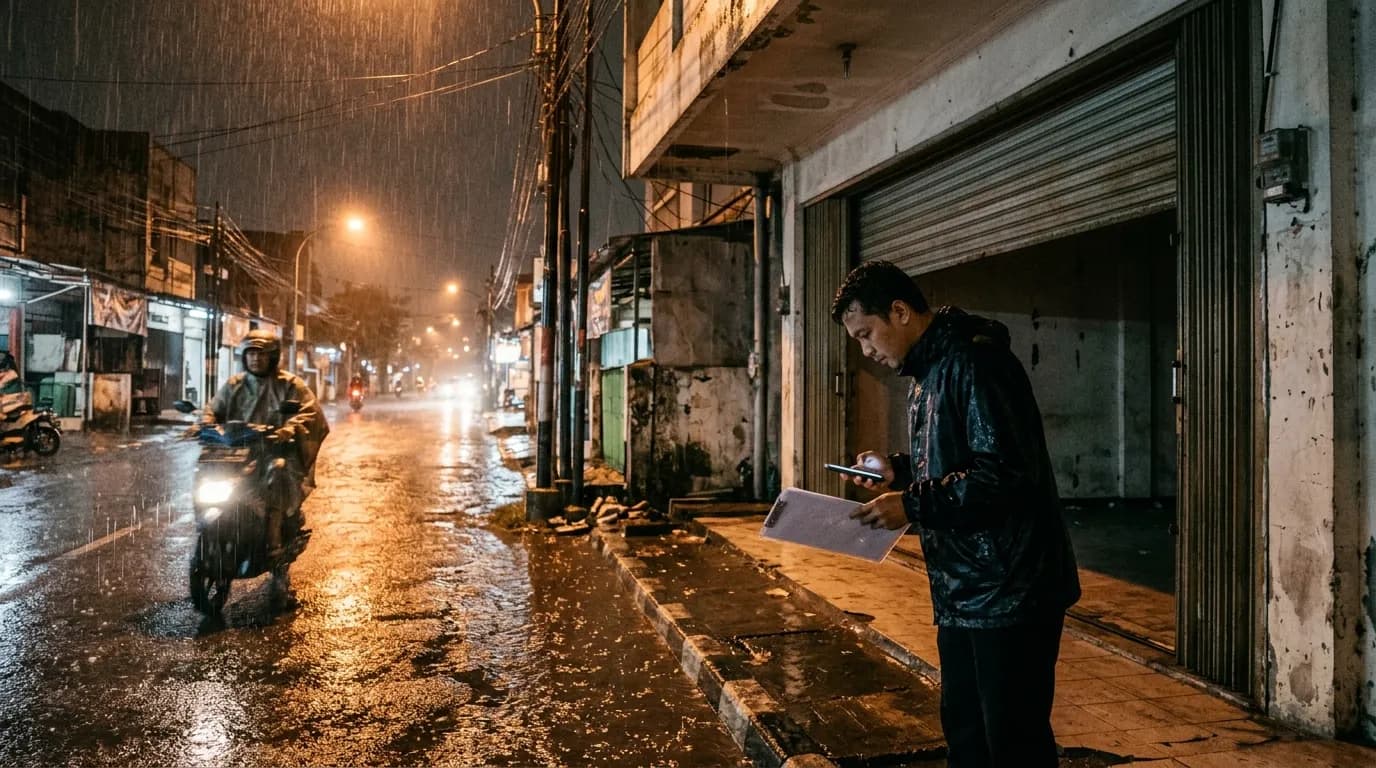
Many tenants visit a potential site only once, usually at midday on a weekday, with the owner or an agent. Yet a shophouse (ruko) that looks ideal at 11 a.m. can be dark and empty at 9 p.m., or under water every time it pours. Problems like these usually surface only after a year's rent has been paid upfront.
You can check most of these risks yourself, with a few planned visits and the same checklist for every candidate site. Here is how.
When should you visit?
Go at least three or four times, at different times:
Visit | What to look for |
|---|---|
Weekday, midday | Office and school activity, the lunch rush, how full the parking is |
Evening | Street lighting, how safe it feels, which businesses are still open |
Weekend | Whether the area stays alive when offices and schools are closed |
During or right after heavy rain | Standing water, run-off, roof leaks, access that gets cut off |
Go alone, without the owner or agent, at least once. To count the people and vehicles passing, use the method in our guide to measuring foot traffic.
Access and parking
How many motorbikes fit in front of the site at peak times? Does the parking space belong to the unit, or is it shared with the neighbours?
Is there a parking attendant (juru parkir)? Ask who runs it and what it charges, because your customers pay it on every visit.
Can ride-hailing (ojek online) drivers stop and wait without blocking the road? This matters if you rely on online orders.
Which direction will customers come from, and how far is the nearest U-turn?
Visibility and signage
Approach the site from both directions on a motorbike at normal speed. At what point does the sign become visible?
Note what blocks the view: trees, power poles and cables, billboards, or a neighbouring building that juts out further.
Ask the owner or estate manager where a sign can go and how big it can be.
On the evening visit, check whether the sign would need its own lighting to stay readable.
The building
Part | What to check |
|---|---|
Rolling door | Opens and closes easily, does not jam, the lock works |
Roof and ceiling | Water stains, sagging ceiling boards, patched spots; check again in the rain |
Drainage | The drain in front is clear, the floor sits higher than the road |
Toilet and water | Water flows well, the source (piped supply from the local utility, PDAM, or a well), no smell |
Electricity | The connected capacity on the PLN meter, the state of the panel and wiring |
Electricity is easy to forget. Older shophouses sometimes have a low connected capacity, while an espresso machine, a freezer, an electric stove and air conditioning may all run at once. Read the VA rating on the meter from PLN, the state electricity company, add up the wattage of everything that runs at the same time, and leave some headroom. You can apply to PLN for more capacity, but there is a connection fee, processing time varies, and the wiring sometimes needs replacing. Agree upfront who pays.
The surroundings
Flood history. Ask neighbours, traders and the security guard (satpam): when it rains hard, how high does the water get and how long does it take to drain? Look for old water lines on walls. Check the area's flood risk on inaRISK, the disaster-risk portal from BNPB, Indonesia's national disaster management agency.
Smells and noise. A rubbish collection point, a blocked drain, a repair workshop or late-night entertainment nearby.
Street lighting. Do the street lights work, or does the area go dark once the shops close?
Safety at night. Would you and your staff feel comfortable closing up at 10 p.m.? Is there a security post? Ask too whether there are regular neighbourhood fees.
Ask the neighbours why the last tenant left
The most valuable questions on a survey are often not for the owner, but for the neighbours:
What business was here before, and how long did it last?
Why did it close or move: too quiet, a rent rise, flooding or trouble with the owner?
On this row, how long does a unit usually stay occupied before it is empty again?
If a row changes tenants often, or "for rent" (disewakan) banners stay up for months, find out why before you become the next tenant.
Documents to ask the owner for
The ownership certificate, and check that the owner named on it is the person signing the lease.
The building approval (Persetujuan Bangunan Gedung, PBG), or the earlier building permit (IMB) for older buildings.
Recent receipts for land and building tax (PBB), electricity and water, to make sure nothing is outstanding.
For zoning and business permits, read our guide to checking zoning and permits before you lease. The rules vary from region to region.
Photograph and note every visit
After three sites and a dozen visits, memories blur together. Every time you go, take photos that record the date and time: the front from both directions, the interior, the ceiling, the electricity meter and the drain. Write a short note in the same format each time: day, time, weather, parking and anything that worries you. With a consistent format, you compare sites fairly rather than favouring the last one you saw.
Narrow the list before you go
Four visits to five candidate sites means twenty trips. So filter first. Compare the areas using BPS demographic data, then check each address with Loka by PetaAI: enter an address and a business type to get a feasibility score, a competitor analysis within a 1 km radius, a transport score from 0 to 100 and a PDF report to bring to your negotiation with the owner.
Data cannot see a leaking roof or the puddle in front of the shop. But it helps you decide which sites are worth four visits, and which you can cross off from the start.
Frequently asked questions
How many times should I survey a location before leasing it?
At least three or four times: midday on a weekday, in the evening, at the weekend, and during or right after heavy rain. Go alone, without the owner or agent, at least once.
What should I ask a shophouse owner during a site visit?
The connected electricity capacity, the flood history and any roof repairs, why the previous tenant left, who pays for repairs during the lease, and the ownership and building permit documents.
How can I tell whether a location floods?
Ask the neighbours and the security guard, look for old water lines on the walls, check the inaRISK portal from BNPB, and visit during or right after heavy rain.
Analyze franchise locations with Loka
Check any spot's potential — POI density, competitors and a viability score in minutes.
Try Loka