Main Road or Inside a Housing Estate: Which Business Location Pays Off?
A main road promises passing trade; a housing estate promises loyal regulars. This guide helps you choose based on how your customers actually arrive, with a table of business types and the checks to run on site.
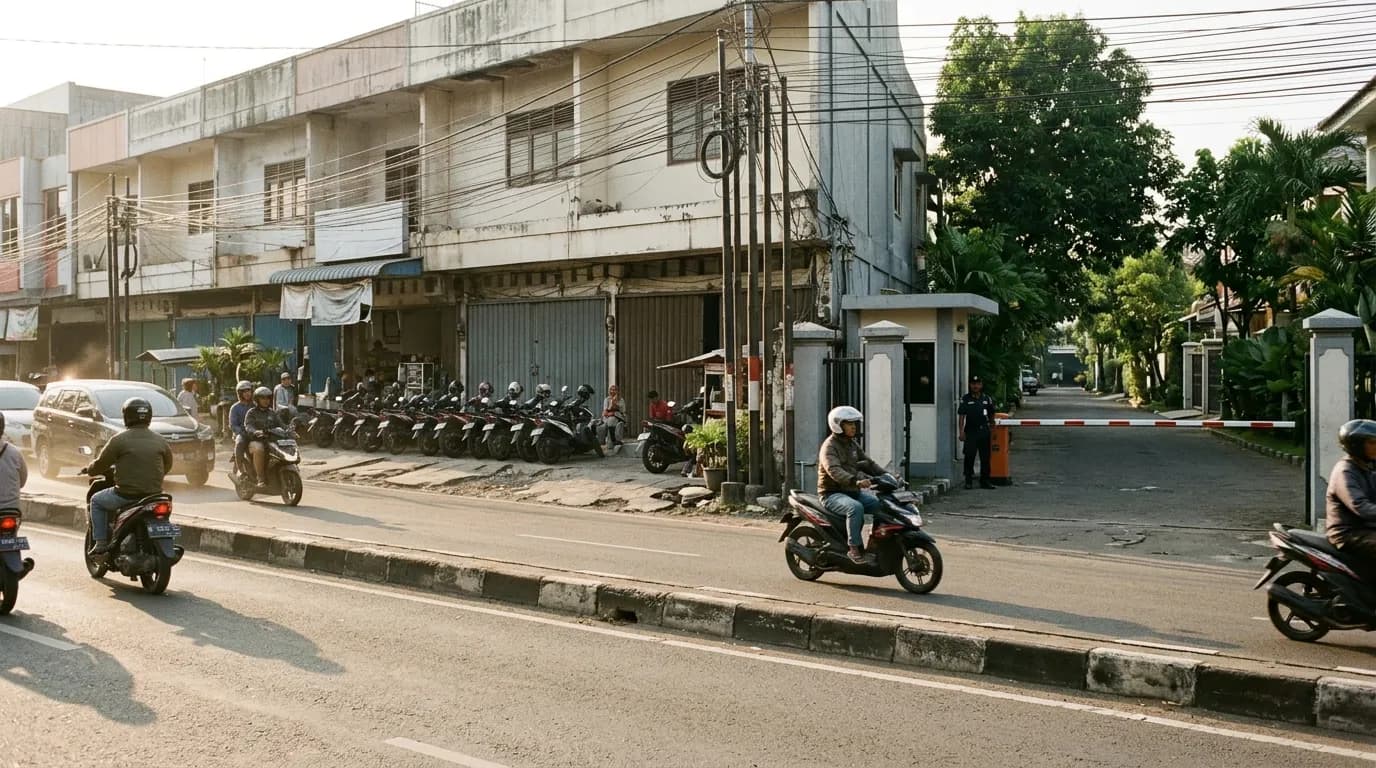
A shophouse (ruko) on a main road looks promising because plenty of people see your sign every day. A unit inside a housing estate (perumahan) feels safer: the rent is lower and the neighbours could become regulars. Either can work, and either can fail.
The choice is often made on gut feeling, not on how customers actually arrive. A coffee shop that lives on impulse buys can go quiet inside an estate, while a residents' laundry can pay main-road rent for no real benefit. With rent usually paid a year upfront, that mistake is expensive.
The real question: how do your customers arrive?
There are two kinds of trip:
Planned visits. The customer sets out to come to you, say to a clinic. They will go a little out of their way if the place is easy to find and has parking.
Impulse or on-the-way buys. The customer buys because they see you on the way, say takeaway coffee or fried snacks (gorengan). They rarely loop back far.
A main road wins for on-the-way buys, but only if vehicles can actually stop. A housing estate wins for residents' routine needs, but its customers are capped by the number of homes.
On the main road: busy does not mean they stop
A main road offers visibility and passing trade. But several things often stop that flow from turning into buyers:
Speed. Fast-moving traffic rarely stops. A congested road or one near traffic lights often beats a wide, free-flowing one.
No parking. No-parking or no-stopping signs, high kerbs and open drains make motorcyclists reluctant to pull over.
Median dividers and U-turns. With a divider down the middle, drivers from the other direction have to turn around. The farther the nearest U-turn (putar balik), the less likely they are to come back.
Which side of the road. For food and drink, the way-home side often does better.
Noise, dust and rent. Main-road rent is generally much higher, and noise and dust discourage customers from lingering.
Inside the estate: loyal regulars, with a ceiling
A business inside an estate has nearby customers who come back again and again. Residents tend to stick with businesses they know, and word spreads fast through residents' WhatsApp groups. But there are downsides:
A hard ceiling on customers. The figures here are only an illustration: 400 occupied homes, with 1 in 10 becoming a regular, gives you about 40 customers. Check that against your break-even calculation.
Gated access. Boom gates (portal), security guards (satpam) and single-gate systems often hold up visitors from outside. A gate that closes at night also cuts your opening hours.
Estate and neighbourhood rules. Many estates and neighbourhood associations (RT/RW) set rules on signage, opening hours and parking.
Zoning. A house in a residential zone cannot always be used for every type of business. Check first with our guide to zoning and permits before you lease.
The middle option: the estate's entrance road
An often-overlooked option is the estate's entrance road, which residents use every time they leave and come home. A site here catches residents on their daily trips, is still visible to outsiders, and usually rents for somewhere in between. Make sure it is the main gate, not a side entrance few people use.
Which business types usually suit which setting
The table shows general tendencies, not rules. Your concept and prices can change the answer.
Business type | Usually suits | Why |
|---|---|---|
Laundry by the kilo (laundry kiloan) | Inside the estate or on its entrance road | A routine need for residents, not reliant on passers-by |
Corner shop or small grocery (warung, toko kelontong) | Inside the estate | Small, frequent purchases within walking distance |
Clinic | Estate entrance road, or a main road with parking | Planned visits that need an easy-to-find site and parking |
Takeaway coffee | Way-home side of a main road, or the estate entrance road | Impulse buys from passers-by who can stop quickly |
Motorbike repair shop (bengkel) | Main road or estate entrance road | Flat tyres happen on the road; regular servicing needs easy access |
Building supplies store | A main road that trucks can use | Buyers come with a purpose and need space to load and unload |
How to decide for your site
Write down your customers' trip type. Are most purchases planned or spontaneous?
Check whether vehicles can stop. Ride to the site by motorbike from both directions at busy times, try pulling over and parking, and measure the distance to the U-turn.
Estimate how many homes the estate has. Ask the estate management or the RT/RW how many homes are occupied, not just built.
Count the people passing. For a main road or entrance road, use the method in our guide to measuring foot traffic.
Comparing candidate sites with Loka
Weighing a main-road shophouse against a house on an estate entrance road? Loka by PetaAI speeds that up. Enter an address and a business type to get a feasibility score based on the proximity, density and quality of nearby amenities, a competitor analysis within a 1 km radius including franchise outlets, a transport score from 0 to 100, and a pricing tier recommendation (Economy, Premium or Super Premium). The results can be downloaded as a PDF report.
Data speeds up the shortlist, but a gate that closes at 9 p.m. or a no-stopping sign outside the shophouse will only show up when you visit in person.
Frequently asked questions
Does a business inside a housing estate need special permits?
You generally still need a business licence through OSS, Indonesia's online licensing system, and the site's zoning must allow your type of business. Estates often have their own rules as well. Requirements differ by region, so confirm with the local investment and licensing office (DPMPTSP).
What businesses work well inside a housing estate?
Businesses that meet residents' routine needs, such as a corner shop, laundry by the kilo, gallon water refills or home catering. Make sure there are enough occupied homes to cover your costs.
Does a main-road location always bring more customers?
Not always. Buyers only come if they can see you early enough, stop easily and avoid a long detour.
Analyze franchise locations with Loka
Check any spot's potential — POI density, competitors and a viability score in minutes.
Try Loka