Opening a Business Near a Campus or School: Big Crowds, Watch the Holidays
Campuses and schools bring big crowds with clear peak hours, but they can go quiet for weeks during the holidays. Learn how to read the calendar, model your slow months and reduce the risk before you lease a space.
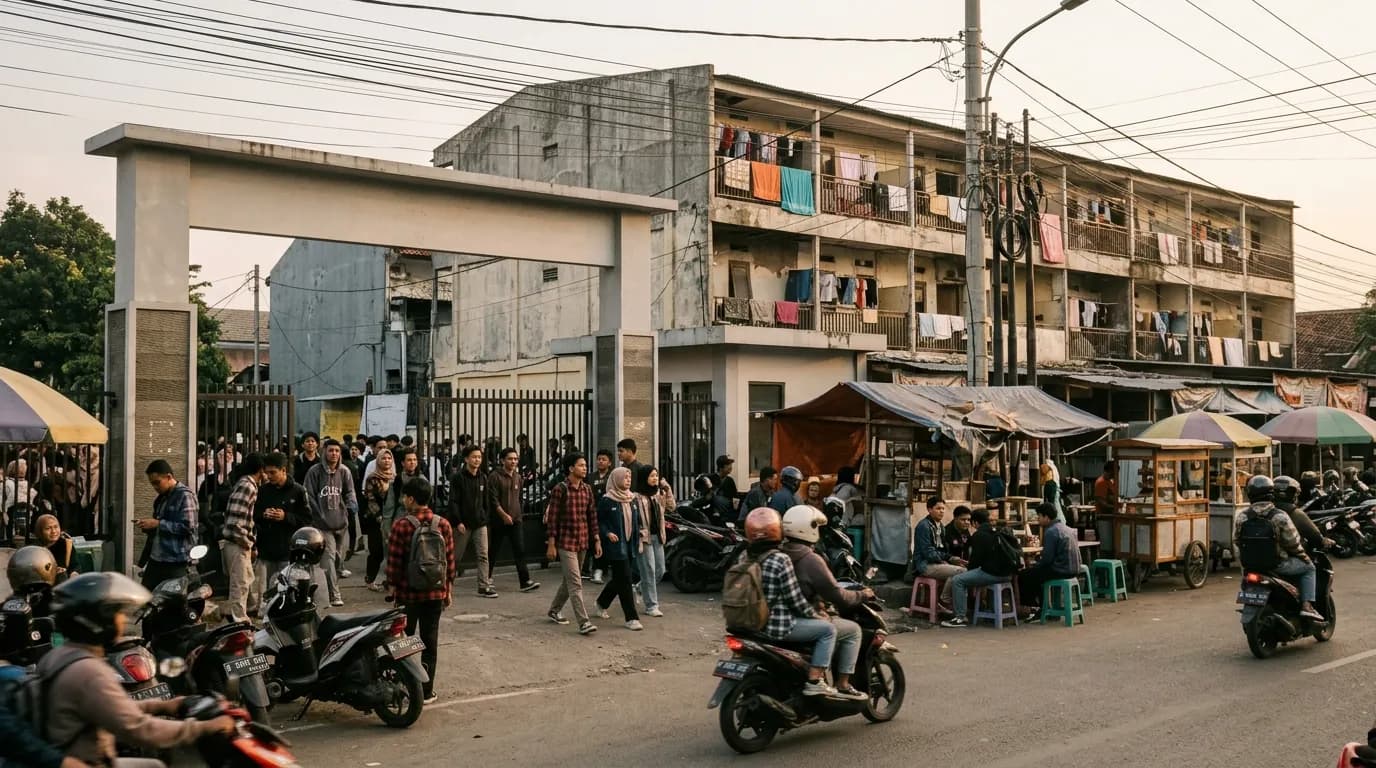
A campus or school looks like the perfect location. Thousands of people arrive almost every day, the busy hours are obvious and the needs repeat: breakfast, coffee, a cheap lunch, photocopying, laundry.
The catch is that the crowd follows the academic calendar. During the semester break or the Lebaran homecoming (mudik), a street usually packed with students' motorbikes can go quiet for weeks, while rent, salaries and electricity keep running. A business planned only on busy-month numbers often runs out of cash in its first holiday season.
Why campuses and schools are attractive
The appeal is a large, regular and predictable crowd. The same people come almost every day, so happy customers quickly become regulars. The peak hours are clear too: the morning before classes, the midday break and the afternoon on the way home. Around a campus ringed with boarding houses (kos), evenings are busy as well.
That pattern makes stock and staffing easier to plan, but the crowd can also all but vanish at certain times of year.
The calendar that shapes your revenue
Map the quiet periods across the year. Exact dates differ by campus and region, so treat this table as a general picture.
Period | Rough timing | Impact on the business |
|---|---|---|
University semester break | Usually around mid-year and around the turn of the year | Out-of-town students go home, boarding houses empty |
School holidays | Usually mid-year and around the end of the year | School runs and children's snack spending pause |
Ramadan and Lebaran | About 10–11 days earlier each year | Daytime food sales usually drop, then out-of-town students go home |
Exam weeks | Towards the end of the semester | Busy hours and spending patterns shift |
How to check:
Find the campus's academic calendar on its official website and note the breaks and exam periods.
For schools, the academic calendar is usually set by the local education office (dinas pendidikan).
Ask boarding-house owners, parking attendants and long-standing traders: which months are quietest, and how quiet do they get?
Not every campus or school is the same
Type of site | Busy hours | Quiet times | Who buys |
|---|---|---|---|
Large campus with many boarding houses | Morning to night, weekends too | Semester breaks and mudik | Students from out of town |
Campus where most students commute | Class hours | Evenings, weekends, holidays | Students arriving by motorbike, KRL commuter train or ride-hailing |
School | Drop-off, break, pick-up | After school, weekends, holidays | Children buying snacks and parents waiting |
Near a commuter campus, access and motorbike parking matter more than the number of boarding houses. At a school you have two sets of buyers: children with limited pocket money, and parents who may buy a coffee or breakfast while they wait.
Students watch every rupiah
Note what nearby food stalls (warung), canteens and cafés charge before you set your menu. The canteen inside the campus or school is often the price benchmark. Offer value bundles, and expect tighter spending towards the end of the month (tanggal tua), when allowances run low. We cover how to read nearby competitors in our article on competitors near your location.
Model the slow months before you lease
Do not plan a full year on busy-month numbers. Model normal months and holiday months separately.
The figures below are an illustration only. Say a coffee shop near a campus has startup capital of Rp155 million, fixed costs of Rp25 million a month and a contribution margin of Rp15,000 per cup. The year has nine normal months averaging 90 cups a day, and three holiday months at only 40% of normal sales.
Scenario | Cups per day | Profit per month |
|---|---|---|
Normal month (9 months) | 90 | Rp15,500,000 |
Holiday month (3 months) | 36 | Loss of Rp8,800,000 |
Full year | – | Rp113,100,000 |
Without the holiday months, the year looks like Rp186 million in profit; with them, it is only about Rp113 million. Startup capital that seemed to come back in about 10 months now takes about 16–17 months, and you need a cash reserve of about Rp26.4 million to cover three months of losses.
See how to work out fixed costs, contribution margin and payback period in our break-even guide before leasing a shophouse.
How to reduce the holiday risk
Survey twice, in term time and during a break, at the same hours and with the same method for counting foot traffic. The difference shows how deep your slow months will be.
Serve other segments, such as local residents, office workers and hospital visitors. They do not go on semester break.
Add delivery or catering to reach nearby residents and office events while the campus is quiet.
Adjust staff and stock by season. Cut fresh stock before the holidays. Part-time staff who are students themselves often go home too.
Open at the start of a semester, not just before a long break.
If you are unsure, test demand on a small budget first. See our comparison of shophouses, kiosks, booths and mall units.
Finding other sources of customers with Loka
The key question here: would your business depend on that one campus? Loka by PetaAI helps you answer it faster: enter an address and a business type to get a feasibility score based on the proximity, density and quality of nearby amenities. A database of more than 39,000 points of interest across 38 provinces, including campuses, offices, malls and hospitals, shows whether other crowd generators nearby keep going during the holidays.
You also get a competitor analysis within a 1 km radius, including franchise outlets, a pricing tier recommendation (Economy, Premium or Super Premium), a transport score from 0 to 100 and a PDF report for a partner or landlord. Loka does not read academic calendars or count visitors live. Use it to shortlist sites, then confirm with a survey in term time and during the break.
Frequently asked questions
What kind of business works near a campus?
Usually businesses that meet students' daily needs: affordable food and drink, coffee shops, pay-by-weight laundries (*laundry kiloan*), photocopying and everyday convenience stores. Choose one that can also serve local residents.
When is the best time to open a business near a campus?
Usually just before or at the start of a new semester, when students return and new students are looking for their regular spots. Avoid opening just before a long break.
Is a business near a school busy all day?
Rarely. Trade usually clusters around drop-off, break time and pick-up, then falls away after school and during the holidays. Check whether those busy hours are enough to cover your daily costs.
Analyze franchise locations with Loka
Check any spot's potential — POI density, competitors and a viability score in minutes.
Try Loka