Delivery-Only Kitchens and Cloud Kitchens: Does Location Still Matter?
A kitchen that only serves delivery orders does not need a busy street, but it still needs the right location. Here are the new criteria: customers in your delivery radius, competitors, rider access and rent per order.
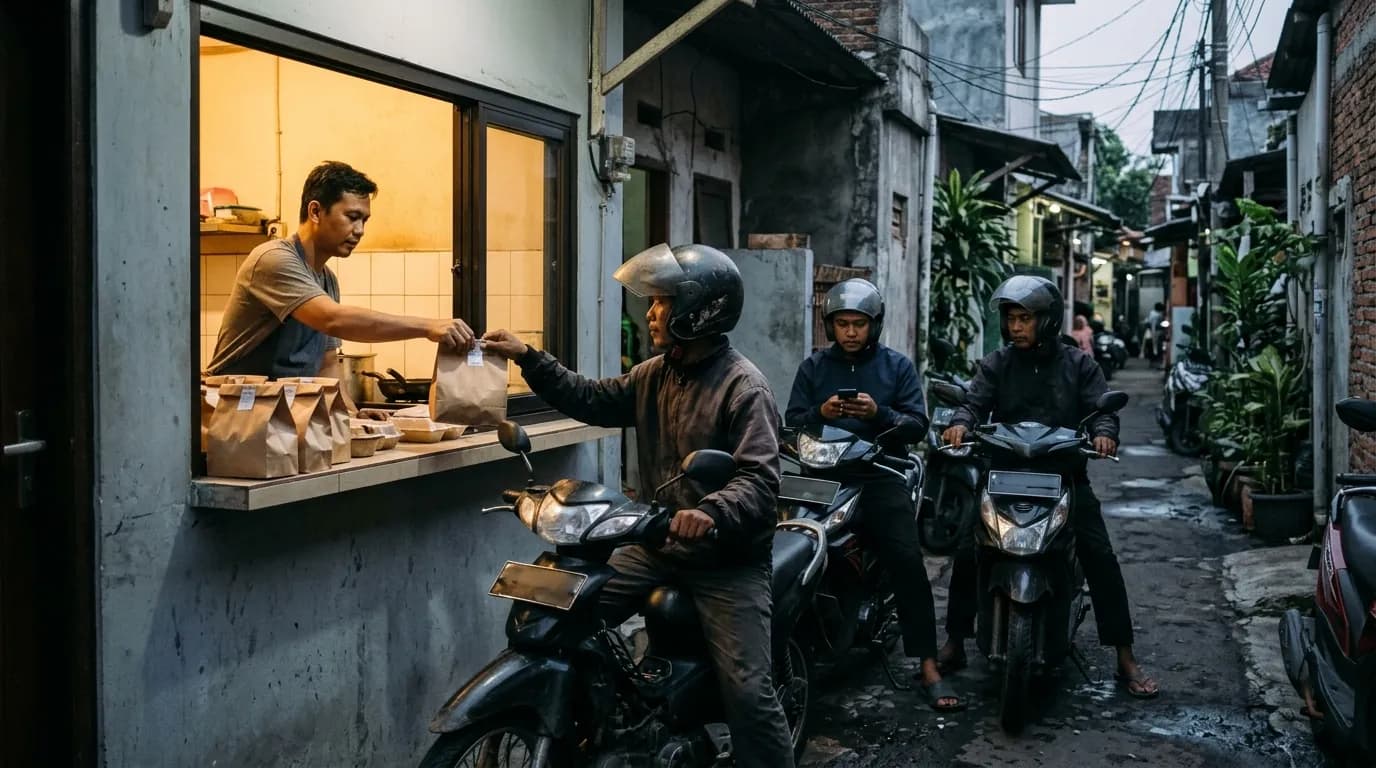
Many people assume a business that only sells through delivery apps can open anywhere. No shopfront, no customer parking, no busy road. Just a kitchen and a merchant account.
That is half true. You no longer need to pay a premium to be seen by passers-by. But the kitchen's location still decides who can order from you, how much they pay for delivery and how quickly the food arrives. A kitchen in the wrong place can sit idle even with a good menu.
The criteria change: from passers-by to people in your delivery radius
For a delivery kitchen, your market is not the people who walk past and drop in, but the people who live, work or study within your delivery radius.
Apps such as GoFood, GrabFood and ShopeeFood tend to show merchants close to the customer first, and delivery fees generally rise with distance. How each app ranks its results is not published in detail and can change, but from the customer's side the logic is simple: a distant kitchen means a higher delivery fee and a longer wait. So your effective market is usually just a few kilometres around the kitchen.
The idea is similar to the catchment area of a physical shop, except the boundary is delivery distance rather than walking distance.
What to check inside your delivery radius
Density of potential customers
List the sources of orders around the candidate kitchen. Each has its own pattern:
Offices: weekday lunches, can be quiet at weekends.
Boarding houses and apartments: evenings and weekends, usually price-sensitive.
Campuses: busy during term, slower over the semester break.
Family housing estates: larger orders, often at weekends.
Make sure there are enough of the sources that match your menu.
Other kitchens already serving the area
Your competitors are every merchant that appears on the same customer's screen, not just the kitchen next door. How to check:
Set the delivery address in the app to the candidate kitchen and a few points around it.
Search your menu category, for example ayam geprek (smashed fried chicken) or rice bowls, and note the number of merchants, the price range, ratings and promotions.
Repeat at lunchtime and in the evening, because different merchants may be open.
Plenty of competitors means demand is proven, but you need a clear point of difference. Read our guide to assessing competitors near your location.
Access for riders
Every minute a rider spends finding your kitchen and waiting there adds to the delivery time. The food arrives colder, and your ratings take the hit. Make sure that:
There is somewhere for ride-hailing riders (ojol) to stop and wait without blocking the road.
The kitchen is not deep inside a narrow alley (gang) that is hard to find from the map pin.
If you are inside a mall, riders do not have to park far away and walk a long way to your unit.
The way in and the nearest U-turn (putar balik) do not force riders into a long detour.
Work out rent per order, not rent per square metre
A regular shop pays high rent for visibility. A delivery kitchen does not need it, so the more useful measure is how much rent each order has to carry.
Rent per order = monthly rent ÷ orders per month
The figures below are an illustration for practising the maths. Replace them with numbers from your own candidate sites.
Item | Kitchen A, main road | Kitchen B, side street |
|---|---|---|
Rent per month | Rp12,000,000 | Rp5,000,000 |
Expected orders per day | 80 | 60 |
Orders per month (30 days) | 2,400 | 1,800 |
Rent per order | Rp5,000 | about Rp2,800 |
Kitchen B takes fewer orders, but each order carries far less rent, provided the kitchen is still close to potential customers and easy for riders to reach. If riders keep getting lost, those 60 orders may never materialise.
Do not forget app commission. It takes a meaningful share of every order and differs by platform, so check the current terms on each app. Treat rent as a fixed cost and commission as a variable cost when you calculate your break-even point.
Three ways to set up a delivery business
Your own small kitchen on a side street. The rent is lower and you are fully in control. In return, you handle the fit-out, smoke extraction, permits and relations with neighbours who may be bothered by cooking smells or waiting riders.
A shared cloud-kitchen facility. Some operators rent out ready-to-use kitchen units in one building, often with a shared pickup area for riders. The upfront cost is generally lower. The downsides: the operator chooses the location, there are service fees on top of the rent, and other brands in the same building may compete in the same radius. Read the contract carefully.
A hybrid with a takeaway window. A kitchen with a small counter for customers who collect their own orders, which gives you a little visibility with nearby boarding-house (kos) residents or office workers. For a cost comparison of each type of space, see our article on shophouses, kiosks, booths and mall units.
Mapping the demand around your kitchen with Loka
Loka by PetaAI speeds up mapping where demand comes from. Enter the address of a candidate kitchen and a business type to see the offices, campuses and other demand-generating places around it, plus competitors within a 1 km radius, including franchise outlets. You also get a feasibility score and a PDF report for comparing candidate sites.
Loka does not show order or delivery data from the apps. Use it to build a shortlist, then check for yourself in the apps and in front of the candidate kitchen at lunchtime.
Frequently asked questions
Does a cloud kitchen need a strategic location?
Yes, but strategic in a different sense. What matters is not a busy road but how many potential customers are within your delivery radius, and easy access for riders.
What is the ideal delivery radius for an online food business?
There is no fixed number, because it depends on traffic, the type of food and the app's settings. Food that cools quickly or goes soggy is better delivered over shorter distances.
Is it better to open my own kitchen or rent space in a shared cloud kitchen?
A shared kitchen suits testing a menu, usually with a smaller upfront investment. Your own kitchen gives you more control over location and long-term costs. Compare the rent per order for both.
Analyze franchise locations with Loka
Check any spot's potential — POI density, competitors and a viability score in minutes.
Try Loka